You Buy Vegetables Every Week Already Knowing You Will Not Actually Eat Them
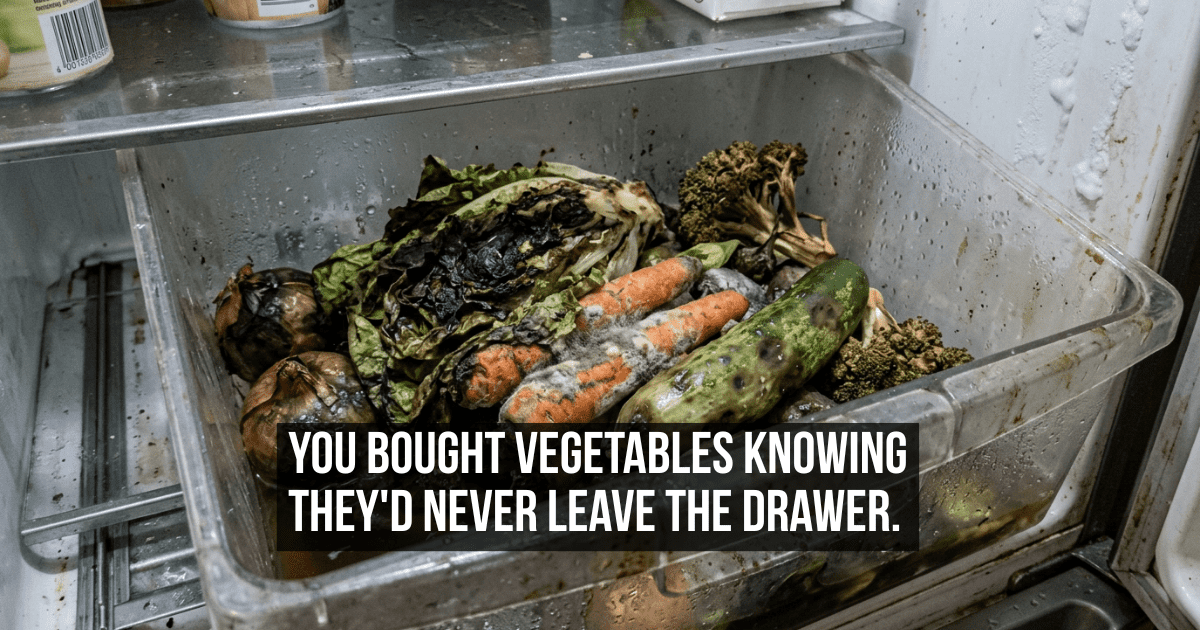
The courgettes are in the drawer. You know they’re in the drawer. You put them there four days ago, when you came back from the shop with intentions that felt, at the time, entirely credible. By Thursday they’ll be a question. By Saturday, a regret. Next Tuesday, you’ll buy more.
You’ve been doing this for years. You’ve known what would happen every time.
The Vegetables Are Not the Problem
Household food waste research consistently finds that fresh vegetables are the category most frequently purchased and least frequently eaten. In the United Kingdom, the average household throws away around 100 kilograms of food per year, with salad leaves, potatoes, and bread among the most wasted items. These are not obscure ingredients. They’re what people think of as healthy eating.
The gap between vegetable purchase and vegetable consumption is not a knowledge problem. You know how to cook courgettes. You know they’re good for you. The information required to eat them is entirely in your possession. What’s missing is not knowledge but something more elusive: the specific configuration of time, energy, and motivation that cooking vegetables from scratch actually requires, on a Tuesday evening when those resources have already been spent.
Purchasing Intention vs. Use Intention
Behavioral economists distinguish between two different mental states that a purchase can involve: intention to buy, and intention to use. For most products, these align closely. For fresh food, they frequently diverge. The supermarket visit happens under optimistic conditions — you’re planning, you’re forward-looking, the week ahead seems manageable. The Tuesday evening when the courgette is actually supposed to become dinner is a different psychological context entirely.
Research from the journal Appetite found that consumers consistently overestimate their future vegetable consumption at the point of purchase, and that this overestimation is not corrected by experience. People who have repeatedly thrown away vegetables continue to predict they’ll eat them next time, because the prediction is made by the planning self, who genuinely believes it.
The buying self and the cooking self are not the same person. They never were.
What Gets Eaten Instead
The substitution pattern is remarkably consistent. When the planned vegetable meal doesn’t happen, what replaces it tends to be something that requires almost no decision-making: pasta with a jar of sauce, eggs, toast, whatever is closest to ready. These aren’t failures of taste. They’re the choices of a person whose cognitive resources have been spent elsewhere.
The fresh vegetable is so vulnerable to abandonment because it requires planning, preparation, and a baseline of motivation that depleted evenings can’t supply. The frozen packet, the tin, the pre-chopped bag — these alternatives succeed not because they’re better but because they meet you where you actually are, rather than where you were on Saturday morning when you planned the week.
The most sustainable vegetable habit would be one designed for the Tuesday self. That self needs dinner in twelve minutes. The courgette needs twenty-five.
What the Drawer Is Actually Holding
The vegetable drawer doesn’t store vegetables. It stores intentions. The courgette sitting in there isn’t food yet — it’s a promise, made on Saturday in a different mood, to a version of the week that didn’t quite materialise.
The real cost isn’t financial, though that’s real enough. It’s the minor erosion of self-trust that comes from repeatedly failing to do something you told yourself you’d do. The rotting vegetable is a small, private accounting of the gap between the self who plans and the self who actually lives through Tuesday evenings.
Next week, you’ll buy more. Because the planning self is optimistic by design, and no amount of Thursday drawers will cure that.
Something went wrong. Please refresh the page and/or try again.
Help us improve your journey
We use cookies to personalize your experience and understand how you use our site. By clicking 'Yes, I'm in!', you help us show you content you'll actually love. If you prefer to keep things simple, you can stick to the essentials. You can change your mind anytime!
Necessary
Always active
The technical storage or access is strictly necessary for the legitimate purpose of enabling the use of a specific service explicitly requested by the subscriber or user, or for the sole purpose of carrying out the transmission of a communication over an electronic communications network.
Preferences
The technical storage or access is necessary for the legitimate purpose of storing preferences that are not requested by the subscriber or user.
Analytics
The technical storage or access that is used exclusively for statistical purposes.The technical storage or access that is used exclusively for anonymous statistical purposes. Without a subpoena, voluntary compliance on the part of your Internet Service Provider, or additional records from a third party, information stored or retrieved for this purpose alone cannot usually be used to identify you.
Advertising
The technical storage or access is required to create user profiles to send advertising, or to track the user on a website or across several websites for similar marketing purposes.




Leave a Reply